
Table of Contents
- What 200 Guests Actually Requires in a Winery Event Space
- Questions to Ask Winery Wedding Venues Before You Book
- Winery Event Venue Pricing Packages: What’s Included
- How to Plan a Stress-Free Winery Wedding for 200
- Accessibility, Weather Contingency, and AV Infrastructure
- Conclusion
- Frequently Asked Questions
Last Updated: September 23, 2026
What 200 Guests Actually Requires in a Winery Event Space
Planning a winery event space for 200 guests comes down to three numbers: seated capacity, standing capacity, and the space between them. Most venues quote a single “capacity” figure, but that number means wildly different things depending on how you use the room. This guide from Aspen Sky, a winery, distillery, and event center, breaks down what 200 guests demand.
Seated Capacity vs. Standing Capacity
Seated capacity is how many guests can eat at tables with chairs; standing capacity is how many can mingle without seating.
Indoor, Outdoor, and Indoor-Outdoor Flow
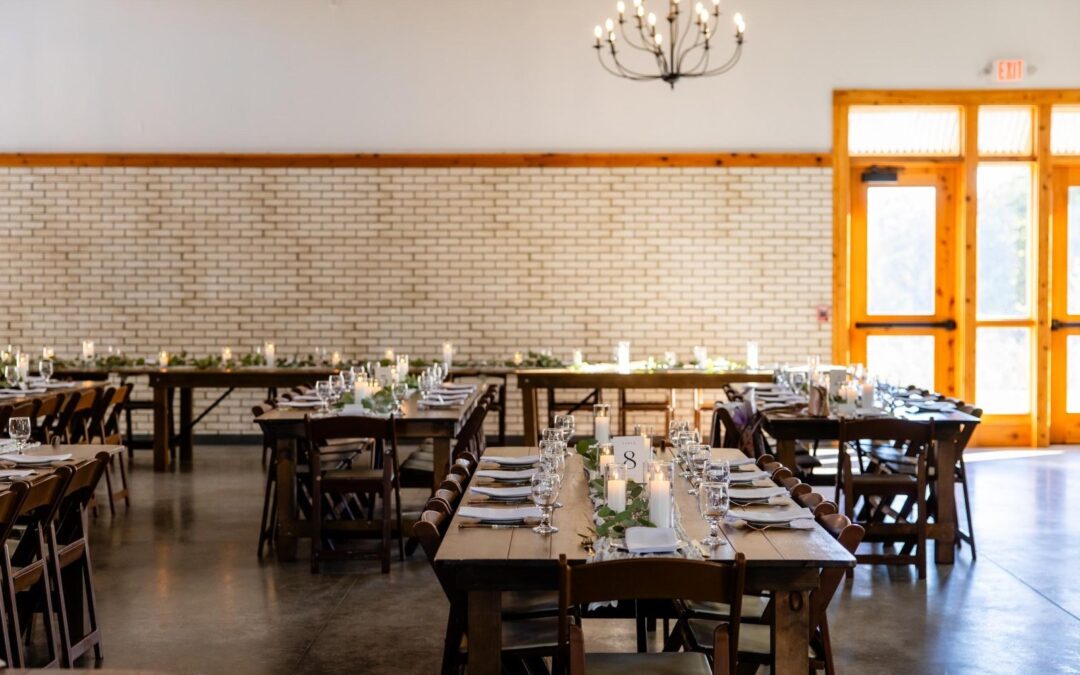
A wide shot of a winery event pavilion set for 200 guests with round tables, white linens, and vineyard views through open barn doors in late afternoon light
Questions to Ask Winery Wedding Venues Before You Book
The right questions to ask winery wedding venues fall into five buckets: capacity, catering, bar, logistics, and flexibility. Ask in writing, and get answers in writing. Checklist for every tour:
- What is the seated capacity and the standing capacity, separately?
- Is there a rain plan, and is it indoors or a tent?
- Is catering in-house or can we bring our own caterer?
- How is the bar priced: consumption, per-person, or package?
- Does the rental fee include tables, chairs, linens, and AV?
- What is the parking capacity, and is there a shuttle service?
- What are the deposit, cancellation, and date-change policies?
- Is the space ADA accessible, including restrooms?
Winery Event Venue Pricing Packages: What’s Included
Winery event venue pricing packages vary widely, and the biggest variable is what’s bundled versus billed separately. Most venues fall into one of three models, and the model you choose changes your budget and planning time.
|
Pricing Model |
What It Typically Covers |
Watch For |
|---|---|---|
|
Venue-only rental |
Space, tables, chairs, basic setup |
Catering, bar, and staff billed separately |
|
Partial package |
Space plus bar or catering |
Add-ons for AV, decor, and overtime |
|
All-inclusive |
Space, food, bar, staff, coordination |
Higher upfront cost, less flexibility |
Rental Fees, Catering, and Bar Costs
Facility rental is the base fee for the space, catering covers the food, and bar costs cover wine, spirits, beer, and staffing. Those three line items are quoted separately in most venue-only and partial-package arrangements, which is why two similar-looking quotes can diverge sharply.
The Line Items That Quietly Add Up at 200 Guests
At 200 guests, small per-person charges compound fast. Price these before comparing venues:
- Staffing ratios. Catering and bar staffing is often quoted per server per hour, and a 200-guest seated dinner needs more servers than a cocktail reception. Ask for the ratio in writing.
- Rental delivery and pickup. Tables, chairs, linens, glassware, and tenting often come from a third-party rental house. Delivery, setup, teardown, and after-hours pickup are separate charges.
- Overtime. Most venue contracts include a defined event window. Extending it, even by 30 minutes, usually triggers hourly overtime plus staff overtime.
- Bar structure. Consumption bar, per-person bar, and hosted-bar packages produce very different totals depending on how much your guests drink. A per-person package caps your exposure; a consumption bar does not.
- Cake cutting, corkage, and vendor meals. Small individually, meaningful in aggregate, vendor meals for a 200-guest event can cover a dozen or more people.
- Security and off-duty officers. Some jurisdictions require paid security for events above a certain size or where alcohol is served. Confirm whether the venue arranges it or you do.
Deposits, Payment Schedules, and Cancellation Terms
Deposit and payment structures matter as much as the headline price. A common pattern is a non-refundable retainer to hold the date, installment payments tied to milestones, and a final balance due shortly before the event. Ask in writing:
- What percentage is due at signing, and is it refundable under any circumstance?
- When are the next payments due, and what happens if a payment is late?
- What is the cancellation policy, and does it change based on how close to the date you cancel?
- Is there a date-change fee, and how many times can you move the date?
- What happens if the venue cancels or becomes unavailable?
How to Plan a Stress-Free Winery Wedding for 200
Planning a stress-free winery wedding for 200 guests starts with locking logistics before decor. Guest count drives seating layout, catering quantities, parking, and staffing.
A realistic timeline helps:
- 12+ months out: book the venue and set the date
- 9 months out: hire catering, bar, photographer, and coordinator
- 6 months out: send save-the-dates and block hotel rooms
- 3 months out: finalize menu, rentals, and shuttle
- 1 month out: confirm final headcount and timeline
- 1 week out: walk the venue with your event coordinator
Parking, Shuttles, and Guest Logistics
Parking capacity is the most under-planned part of a 200-guest event. If the venue holds 60 cars and you have 200 guests, you need a shuttle. A common approach is shuttles from a nearby hotel or central lot, reducing on-site congestion and giving guests a safe ride if they’re drinking. Ask about drop-off zones, ADA parking, and how the shuttle schedule aligns with your ceremony and reception times.
Accessibility, Weather Contingency, and AV Infrastructure
Accessibility, weather contingency, and AV infrastructure are the three details most couples only think about after booking. Each can make or break a 200-guest event, and venue marketing pages rarely cover them.
Learn More About Events at Aspen Sky →
Accessibility and ADA Compliance
Accessibility and ADA compliance means step-free entry, accessible restrooms, and seating that accommodates wheelchairs and mobility aids. Confirm this before you sign. The ADA National Network guidance on accessible event venues notes that accessibility covers parking, entrances, restrooms, and seating, not just a ramp at the front door.
- Accessible parking. How many accessible spaces are there, and how close are they to the entrance? At 200 guests, accessible parking can fill quickly.
- Path of travel. Is the route from parking to the event space paved, firm, and step-free? Gravel, grass, and cobblestone are common at wineries and can be impassable for wheelchairs and walkers.
- Restrooms. Are there accessible stalls, and are they reachable without stairs or narrow doorways? Portable units are sometimes used as overflow, confirm whether any are accessible.
- Seating. Can a wheelchair user sit at a standard round table without blocking the aisle? Ask whether the venue has removable chairs and adjustable-height tables.
- Service animals. Confirm the venue’s policy, since some wineries have on-site animals or food-service rules that staff may misapply.
Weather Contingency Planning
Weather contingency planning means a real indoor backup, not just a tent promise. For outdoor ceremonies, ask what triggers the move indoors and who decides. At 200 guests, the call must come early enough to move chairs, reset tables, and redirect vendors, not when the first raindrop falls. Such logistical foresight should extend to the flow of your floor plan, as planning restroom requirements is essential to maintaining guest comfort when moving a large crowd between indoor and outdoor spaces.
A workable weather plan answers four questions:
- What is the trigger? A specific forecast threshold, a time of day, or a call by the venue’s event coordinator? Get the trigger in writing.
- Who decides? The couple, the planner, or the venue? Ambiguity here is how events end up half-indoors and half-outdoors.
- What is the backup space, and does it hold 200? A tent that seats 120 is not a backup for a 200-guest reception. Confirm the seated capacity of the backup space, not just its existence.
- How long does the move take? A full reset for 200 guests can take hours. If the trigger is too late, the move cannot happen in time.
AV and Technical Infrastructure
Ask these questions before you book:
- Microphones. How many wireless handheld and lavalier microphones are available, and are they included or rented? For a 200-guest event, plan on at least two handhelds for toasts and one lavalier for the officiant.
- Sound system. Is there a house system with coverage for both indoor and outdoor spaces, or does the DJ or band bring their own? If the ceremony is outdoors and the reception is indoors, you may need two setups.
- Power. Where are the outlets, and how many circuits are available? Bands, DJs, catering equipment, and lighting all draw power, and older winery buildings sometimes have limited capacity.
- Wi-Fi and cell service. Rural wineries often have weak cell coverage. If you plan a livestream, a slideshow, or vendor coordination by phone, confirm Wi-Fi bandwidth and whether it is shared with other events.
- Lighting. Uplighting, string lights, and stage lighting are frequently rented separately. Confirm what is permanent versus what you need to bring in.
- Setup and teardown. Who runs the AV during the event, and what happens if something fails mid-toast? A venue with an on-site technician beats one that hands you a cable and wishes you luck.
Conclusion
Hosting 200 guests at a winery is doable when the venue handles capacity, catering, and logistics as one system rather than a list of separate vendors. The couples who enjoy their day most asked hard questions early and picked a venue that could answer them.
Frequently Asked Questions
How much space do you need for 200 guests at a winery?
Plan for roughly 1,200 to 1,500 square feet for seated dining at 200 guests, plus additional room for a dance floor, bar, and buffet. A winery event space for 200 guests should offer both a seated capacity and a standing capacity figure so you know how the room performs for dinner versus cocktail hour. Ask whether the venue’s headcount includes staff, vendors, or your band.
What questions should I ask a winery venue coordinator before booking?
Ask about seated versus standing capacity, whether catering and bar are in-house or outside, rental fee inclusions, overtime charges, gratuity and tax treatment, insurance requirements, and cancellation or date-change policies. Also confirm parking capacity, shuttle options, ADA accessibility, and weather backup plans. Getting these answers in writing before you sign prevents surprise fees later.
How far in advance should I book a winery venue for 200 people?
Most wineries with capacity for 200 guests book 9 to 18 months out for peak Saturday dates between May and October. Holiday weekends and fall dates go first. If your date is flexible, off-season or Friday and Sunday events often open up sooner. Start touring venues at least a year ahead so you have real options rather than leftovers.
What should winery event venue pricing packages include?
A typical package covers the facility rental, tables, chairs, linens, and sometimes bar service. Catering, alcohol, staffing, and gratuity are often separate line items. Ask whether pricing is tax inclusive, what the overtime rate is, and whether there is a food and beverage minimum. Compare the total event cost, not just the rental fee, before deciding.
How do you handle weather if your winery event is outdoors?
Ask for a written rain plan before you book. A good winery event space for 200 guests has an indoor or covered backup that can seat the same headcount without rearranging your layout. Confirm how late you can make the call to move indoors, who decides, and whether tent rentals are allowed on the property if the venue itself has no covered option.