
Table of Contents
- Quick Comparison: Non-Hotel Meeting Venues at a Glance
- Benefits of Offsite Meetings Beyond Hotel Conference Rooms
- How to Choose a Meeting Venue That Fits Your Event
- Meeting Space Rental Costs: What to Expect
- Top Alternatives to Traditional Hotel Meeting Rooms
- Why Aspen Sky Stands Out as a Non-Hotel Venue
- Frequently Asked Questions
Last Updated: September 17, 2026
Quick Comparison: Non-Hotel Meeting Venues at a Glance
Hotel meeting rooms have long been the default for corporate gatherings, but that default costs teams money and energy. Alternatives to traditional hotel meeting rooms now range from hourly coworking rentals to full winery event centers, and many deliver better AV infrastructure, more flexible booking terms, and a more productive atmosphere. This guide from Aspen Sky breaks down what each option offers, what it costs, and how to pick the right one.
|
Venue Type |
Typical Booking Model |
Best For |
Watch Out For |
|---|---|---|---|
|
Coworking and flexible workspaces |
Hourly or daily |
Small teams, workshops |
Limited capacity for large groups |
|
Winery and distillery event centers |
Half-day or full-day |
Weddings, fundraisers, training |
Seasonal availability in some cases |
|
Outdoor and unique venues |
Varies by site |
Team building, informal offsites |
Weather contingency planning required |
|
Hotel conference rooms |
Daily, with minimums |
Large conferences |
Mandatory catering and service fees |
Benefits of Offsite Meetings Beyond Hotel Conference Rooms
Offsite meetings deliver what a hotel ballroom rarely does: a change of context that resets how people think and interact. When a team leaves its usual environment, attention shifts from routine to the task at hand, the entire point of an offsite.
The benefits stack up quickly:
- Fewer interruptions. No one ducks out to check their desk.
- Better collaboration. Neutral ground flattens hierarchy and encourages input.
- Stronger retention. People remember experiences, not conference room chairs.
- More flexibility. Non-hotel venues rarely impose rigid catering or scheduling rules.
How to Choose a Meeting Venue That Fits Your Event
Choosing a meeting venue comes down to five variables: capacity, infrastructure, logistics, budget, and contract terms. Most planners who regret a venue choice skipped one of these, not because the room was ugly.
- Theater-style (rows of chairs): the highest density, best for presentations and keynotes.
- Classroom (tables with chairs facing forward): roughly half the theater count, best for training.
- Rounds of 60 inches or Rectangles: typically seats 8 per table with comfortable spacing, best for dinners and workshops.
- U-shape or boardroom: the lowest density, best for decision-making groups of 12 to 24.
- Reception/standing: the highest practical count, but only for short programs.
- Dedicated upload bandwidth (not shared guest Wi-Fi) sufficient for your platform’s recommended bitrate at your expected resolution.
- A wired ethernet drop or a hardline adapter at the presenter position.
- Camera coverage of both the presenter and the room, not just a laptop webcam pointed at a wall.
- Ceiling or table microphones with echo cancellation, plus a way to mute the room.
- A display large enough that remote attendees’ faces are visible to in-room participants.
- A designated on-site contact who can troubleshoot during the event.
- Cancellation and force majeure language, including what happens if the venue’s own permits or liquor license lapse.
- Whether the venue requires you to carry event liability insurance and, if so, at what limits and whether the venue must be named as an additional insured.
- Whether the venue carries its own general liability and liquor liability coverage, and whether it will provide a certificate of insurance on request.
- Who is responsible for damage to the space, and whether a security deposit is refundable.
- Whether outside catering and alcohol are permitted, and what corkage or service fees apply if they are.
- Whether the venue has a noise ordinance curfew that will end your event earlier than planned.
Meeting Space Rental Costs: What to Expect
How each venue type prices.
- Hotels typically quote a room rental that is waived or reduced if you hit a food and beverage minimum, then add a service charge (commonly in the 18 to 24 percent range) and state and local sales tax on top. Audio-visual is almost always a separate, marked-up line item, and outside AV vendors are often restricted or subject to a fee.
- Coworking and flexible workspaces usually bill by the hour or by the day, with AV, Wi-Fi, coffee, and often a receptionist included. There is rarely a food and beverage minimum, and you can usually bring in your own catering.
- Event centers and dedicated venues often price in half-day or full-day blocks and may bundle tables, chairs, linens, bar service, and staffing. Read the package carefully, “included” items are frequently capped.
- Restaurants and private dining rooms frequently impose a per-person food and beverage minimum rather than a room fee, efficient for small groups, punishing for large ones that do not drink.
- Outdoor and unique venues may charge a flat site fee plus separate charges for power, restrooms, tents, and staffing, and may require additional insurance.
The line items that surprise planners.
- Service charge and gratuity, which are often the same line item and are calculated on the food and beverage subtotal, not the room fee.
- State and local sales tax on both the room and the catering.
- Corkage or bottle fees if you bring your own alcohol.
- Security or off-duty officer requirements for events over a certain headcount or serving alcohol.
- Cleaning and damage deposits, refundable only if the venue agrees the space was left in acceptable condition.
- Overtime charges if your event runs past the contracted end time, usually billed in 30- or 60-minute increments.
- Parking, coat check, and Wi-Fi surcharges at hotels.
|
Cost Factor |
Hotels |
Coworking |
Event Centers |
|---|---|---|---|
|
Room fee |
Daily rate, often tied to F&B minimum |
Hourly or daily |
Half or full day |
|
Catering |
Often required, in-house only |
Optional, outside allowed |
Package options, sometimes exclusive |
|
Service charge |
Commonly 18-24% |
Rare |
Varies |
|
AV equipment |
Rental fees, marked up |
Often included |
Varies |
|
Insurance requirement |
Sometimes |
Rarely |
Often for alcohol or large events |
|
Cancellation terms |
Tiered, sometimes strict |
Usually flexible |
Varies by venue |
U.S. Bureau of Labor Statistics data on meeting and event planning costs
Top Alternatives to Traditional Hotel Meeting Rooms
The best alternatives to traditional hotel meeting rooms are coworking spaces, event centers, and outdoor or unique venues. Each solves a different problem, and the right pick depends on group size, budget, and the tone you want to set. Teams seeking to foster deeper connection or mental clarity often find that unique wellness retreat venues provide a more restorative atmosphere than standard corporate settings.
Coworking Spaces and Flexible Workspaces
Coworking spaces rent professional meeting rooms by the hour or day, with no long-term contract and no catering minimum. Providers like Peerspace list creative spaces starting around $55 per hour, while Office Evolution and Alliance Virtual Offices offer business-grade rooms with reception support and AV equipment included. For a training session or workshop of 10 to 20 people, this is often the most cost-effective option.
Winery and Distillery Event Centers
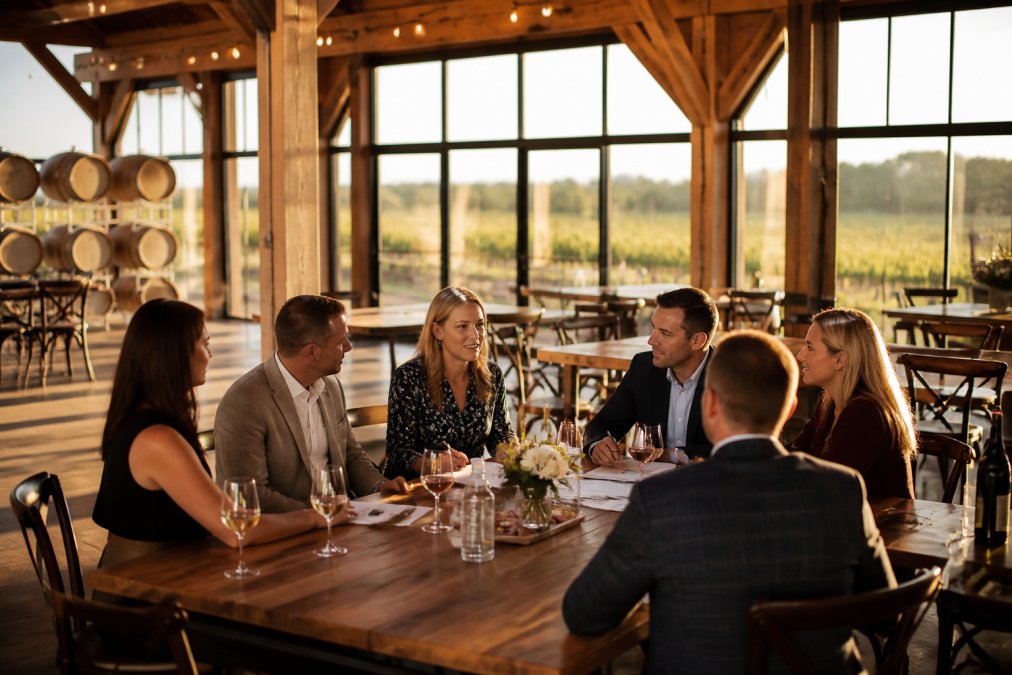
Winery and distillery event centers combine atmosphere with full-service event management, handling catering, bar setup, and seating in one place, no piecing together a venue, caterer, and bartender separately. Capacity is the big advantage: Aspen Sky accommodates up to 270 guests across indoor and outdoor spaces, a fit for weddings, fundraisers, and multi-day corporate retreats. Booking tends to be seasonal, so plan around harvest and holiday calendars.
Outdoor and Unique Venues
Outdoor and unique venues trade predictability for memorability. A vineyard lawn, covered patio, or converted industrial space can make a team-building day feel like an event rather than a meeting. The catch is infrastructure: confirm power access, restrooms, weather contingency plans, and video conferencing support for remote participants before you commit. These venues work best for informal offsites and social gatherings where flexibility matters more than a fixed floor plan.
Why Aspen Sky Stands Out as a Non-Hotel Venue
Aspen Sky is a winery, distillery, and event center in one location, so your group gets hand-crafted wines and spirits, a full bar with beer selections, and food in a single booking. The venue holds up to 270 guests across modern indoor and outdoor spaces, scaling from an intimate team dinner to a full wedding or company fundraiser.
Frequently Asked Questions
What are the benefits of choosing a non-hotel venue for corporate meetings?
Non-hotel venues like wineries, coworking spaces, and outdoor event centers offer a more relaxed atmosphere that can boost creativity and engagement. They often provide unique amenities such as craft beverages, flexible layouts, and AV production support. Costs can be lower because you avoid mandatory hotel catering and service fees. In practice, teams report higher satisfaction and better collaboration when meetings feel less formal and more inspiring.
How do winery and distillery event centers compare to hotel conference rooms?
Winery and distillery event centers typically offer a more inviting, social environment with in-house beverages and catering. They can accommodate a range of group sizes, from intimate gatherings to large receptions, and often include both indoor and outdoor spaces. Unlike many hotel conference rooms, these venues may not require you to use their exclusive AV vendor, giving you more flexibility and potential cost savings. However, you should confirm capacity, parking, and technical infrastructure before booking.
What factors influence the cost of renting non-traditional meeting spaces?
Meeting space rental costs depend on location, day of the week, duration, and included amenities. Peak seasons and weekends generally cost more. Venues may charge hourly or daily rates, and some require minimum food and beverage spending. Additional fees can apply for AV equipment, staffing, and cleanup. Always request a detailed quote and ask about hidden charges like overtime or security deposits to avoid surprises.
Are coworking spaces suitable for large-scale corporate events?
Coworking spaces work best for small to medium meetings, workshops, or training sessions. For large-scale events with hundreds of attendees, you’ll likely need a dedicated event center or winery with ample capacity and breakout areas. Some coworking brands offer event spaces that can be combined, but check maximum occupancy, parking, and catering options. For big corporate retreats, a venue like Aspen Sky that accommodates up to 270 guests is a better fit.
What amenities should I look for when booking an alternative meeting space?
Prioritize high-speed internet, reliable AV production, comfortable seating, and climate control. If you’re hosting a hybrid meeting, confirm video conferencing capabilities and camera setups. Catering services, parking, and accessibility are also important. For offsite meetings, consider breakout sessions spaces, outdoor areas, and on-site beverage service. A venue that provides these amenities reduces logistical headaches and keeps attendees focused.