
Last Updated: November 19, 2026
Quick Summary
Wedding venue accessibility means guests with mobility needs, older relatives and anyone recovering from an injury can arrive, move between spaces, rest and take part comfortably. Ask about parking, step-free entrances, accessible restrooms, ADA compliance, sensory access and emergency planning, and get every commitment in writing.
- Confirm how far accessible parking is from the main entrance and whether there is a covered drop-off area.
- Ask whether the main entrance is step-free and what the ramp slope and width are.
- Check that accessible restrooms are on the same floor as the ceremony and reception spaces.
- Ask whether the venue is ADA compliant and can explain how it meets the standards.
- Put every accessibility commitment in the contract, since verbal promises are easy to forget.
Table of Contents
Asking the right questions about wedding venue accessibility is one of the most important steps you can take when choosing a space for your big day. For a broader checklist, read what to look for in wedding venues. At Aspen Sky, we’ve learned that guests with mobility needs, older relatives and anyone recovering from an injury deserve to enjoy the celebration as much as everyone else. Planning ahead makes that possible.
Accessibility is not only about a wheelchair ramp. It covers how guests arrive, how they move between rooms, where they can rest, and whether they can hear and see what is happening. A venue can look beautiful and still leave a grandparent with a walker stranded at the bottom of a staircase.
When you tour a venue, ask specific questions and expect specific answers. Vague reassurances like “it’s all accessible” are a warning sign. Below, we walk through nine questions to ask, grouped by the part of the day they affect most.
Questions About Parking, Drop-Off and the Arrival Route
Start with the first thing every guest experiences. Ask how far accessible parking is from the main entrance, and whether there is a covered drop-off area close to the door.
- How many accessible parking spaces are available, and how close are they to the entrance?
- Is there a drop-off zone where guests can be let out without crossing a long distance?
- Is the path from parking to the entrance paved, level and free of gravel or loose stones?
A common mistake is assuming a guest will be fine walking a short distance. On a windy outdoor afternoon, that short walk can feel very long.
Questions About Entrances, Ramps and Step-Free Routes
Once guests reach the door, the next question is whether they can get through without stairs. Ask whether the main entrance is step-free, and if not, where the nearest alternative entrance is located.
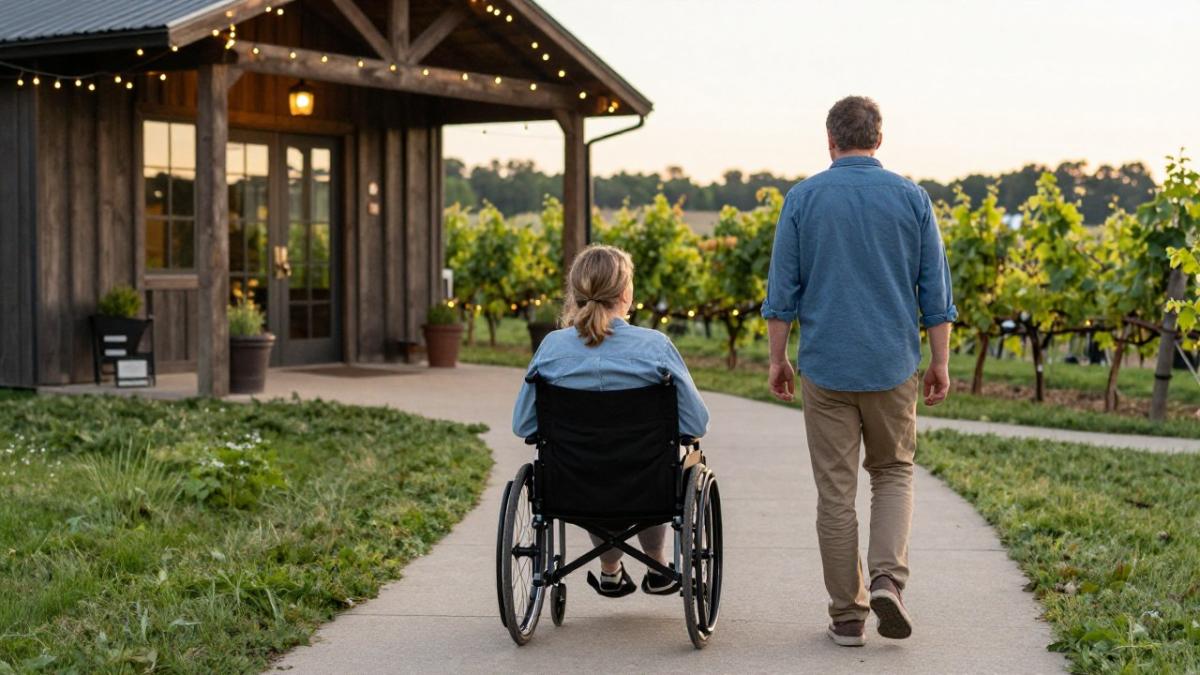
- Is there a ramp, and what is its slope and width?
- Are doorways wide enough for a standard wheelchair to pass through comfortably?
- Can you walk the full route from the parking area to the reception space with someone who uses a mobility aid?
Walking the route yourself, ideally with an older relative or a friend who uses a walker, is the best test you can run.
Questions About Restrooms, Floor Plans and Room Access
Restrooms are where accessibility problems often show up. Ask how many accessible restrooms the venue has, where they are, and whether they sit on the same level as the ceremony and reception spaces.
Ask for a floor plan. A floor plan shows how the ceremony room, reception space, bar and outdoor areas connect, which is key to judging wedding venue accessibility. Look for distance between spaces and whether guests must climb stairs or cross uneven ground to move around.
-
Are the accessible restrooms on the same floor as the event spaces?
-
Are there any room restrictions, such as areas that are closed during certain hours?
Questions About ADA Compliance, Sensory Access and Emergency Planning
Ask whether the venue is ADA compliant. The Americans with Disabilities Act sets the federal standards for accessibility in public spaces, and a reputable venue should be able to explain how it meets them (ADA Standards for Accessible Design). You can review the requirements directly on the ADA Standards for Accessible Design.
Accessibility also includes guests who are deaf or hard of hearing, or who have low vision. Ask whether the venue has a quiet room, whether microphones and sound systems can be adjusted, and whether lighting is bright enough for guests to read the program.
Emergency planning matters too. Ask how staff assist guests who need help evacuating, and whether there is a clear, accessible exit route from every event space.
Questions to Ask Before Signing the Contract
Before you commit, confirm every accessibility detail in writing. Verbal promises are easy to forget on a busy event day. Ask the venue to include accessibility commitments in your contract, such as the number of accessible restrooms, the availability of ramps, and the layout you agreed to.
For current pricing and what each package includes, visit the Aspen Sky website or request a quote. For a broader look at what matters in a wedding venue, read [our guide to what to look for in wedding venues | page:3]. If you are ready to book, [explore the wedding options at Aspen Sky | page:1] to see the spaces and services available.
Questions to Ask at Your Final Meeting Before the Wedding
Your final meeting is the time to confirm the details. Ask who your main point of contact will be on the day, and whether venue staff know the accessibility arrangements you discussed.
Confirm access hours for setup with your coordinator, so that any rental equipment, such as a ramp or extra seating, is in place before guests arrive. Double-check that the date and space you booked are still available with your coordinator.
Walk the full route one more time, from parking to the ceremony space to the restrooms. Note any obstacles, such as a temporary barrier or a doorway propped open by a delivery cart, and ask staff to clear them before the big day.
With these nine questions in hand, you can compare venues with confidence and choose a space where every guest can celebrate comfortably.
Frequently Asked Questions
Is a wedding venue required to be ADA compliant?
Under Title III of the Americans with Disabilities Act, places of public accommodation, which includes most event venues open to the public, must remove barriers where removal is readily achievable and must provide accessible routes, restrooms and parking where feasible. Private events held at a venue are generally covered when the venue is a public accommodation. Ask the venue directly which features it has, which it is working on, and how it handles guests who need a step-free route. Get any commitments in writing before you sign.
How can I check whether a wedding venue is accessible for wheelchair users?
Ask for the distance from the parking area to the main entrance, whether there are steps or only ramps, the width of doorways and corridors, and whether the restrooms and ceremony space are on the same level. Request photos or a walkthrough video of the route your guests will take. Ask whether the venue can provide a temporary ramp or a rented wheelchair for guests on event day. Verify answers at your site visit rather than relying on the website alone.
What should be confirmed in the venue contract about accessibility?
Put every accessibility commitment in writing, including accessible parking spaces, drop-off location, step-free routes, accessible restroom locations, seating for guests who need it and any temporary equipment the venue will supply. Confirm who is responsible if a feature is unavailable on the day, and what happens if a guest needs a service animal or mobility device accommodated. A verbal promise from a sales contact is not enforceable.
Can the venue accommodate service animals and mobility devices?
Service animals are generally permitted in public areas of a venue under federal law, and mobility devices such as walkers and wheelchairs must be accommodated. Ask how much clear floor space the venue provides between tables, whether the dance floor and bar are reachable without stairs, and whether staff are trained on accessibility. Share your guest list needs early so the venue can plan seating and routes.
