
Last Updated: November 1, 2026
Quick Summary
Natural wine is a loosely defined category with no federal legal definition in the United States, typically made from grapes grown with minimal intervention, fermented with native yeasts, and with few or no additions in the cellar. Conventional wine covers most store-shelf bottles, which may use synthetic inputs, cultured yeast, and a broader list of permitted additives. The difference is a matter of degree, so the label alone often does not settle it.
- Natural wine has no federal legal definition in the United States, so the word alone is not a guarantee.
- Natural winemakers usually ferment with native yeasts, while conventional producers often add cultured yeast strains.
- Many natural wines are unfiltered and unfined, which is why they often look cloudy or show sediment.
- Every wine contains some naturally occurring sulfur dioxide, so “Contains Sulfites” does not reveal added sulfur.
- Ask producers about farming, yeast, added sulfur, and filtration to compare bottles more reliably than front labels.
Table of Contents
- What Natural Wine and Conventional Wine Actually Mean
- Vineyard Practices: Organic, Biodynamic and Conventional Farming Side by Side
- Cellar Practices: Fermentation, Filtration and Fining Compared
- Natural Wine Additives: What Is Allowed and What Is Not
- Natural Wine Sulfites: Added Versus Naturally Occurring Levels
- Natural Wine Taste: Why Bottles Vary So Much
- Reading Labels and Choosing a Bottle for Your Next Dinner
- Frequently Asked Questions
Natural wine and conventional wine often sit side by side on the same shop shelf, yet the labels rarely explain what separates them. That gap confuses plenty of American drinkers, especially at dinner, when a bottle choice matters. Here is what really differs, and what doesn’t.
What Natural Wine and Conventional Wine Actually Mean
Natural wine is a loosely defined category, not a regulated one. In the United States, there is no federal legal definition of “natural wine,” so producers use the term in different ways. Most natural winemakers work with grapes grown with minimal intervention and ferment them with native yeasts, adding little or nothing in the cellar.
Conventional wine covers the broad majority of bottles on store shelves. Growers may use synthetic pesticides and fertilizers, and winemakers may add commercial yeasts, acid, tannin, and other permitted additions. The line between the two categories is a matter of degree, and the label often does not settle the question.
Vineyard Practices: Organic, Biodynamic and Conventional Farming Side by Side
Vineyard work is where the biggest philosophical differences begin. Conventional vineyards often rely on synthetic pesticides, herbicides, and chemical fertilizers to protect yields. Organic farming avoids most synthetic inputs and relies on cover crops, compost, and natural pest controls. Biodynamic farming goes further, following a calendar and a set of preparations based on the work of Rudolf Steiner.
Organic certification in the United States is administered by the USDA National Organic Program, which sets rules for both farming and processing. Look for the specific certification wording on the label.
Many natural winemakers farm organically or biodynamically, but not all of them certify. Read about how one Wisconsin winery approaches its own vineyard and winemaking philosophy. Some farm this way and never pursue paperwork. Others certify but add little in the cellar. Treat farming and cellar practice as two separate questions.
Cellar Practices: Fermentation, Filtration and Fining Compared
Fermentation is the step where grape juice becomes wine. Natural winemakers usually rely on indigenous yeasts that live on the grape skins and in the winery environment. Conventional producers often add cultured yeast strains, which give more predictable results from batch to batch.
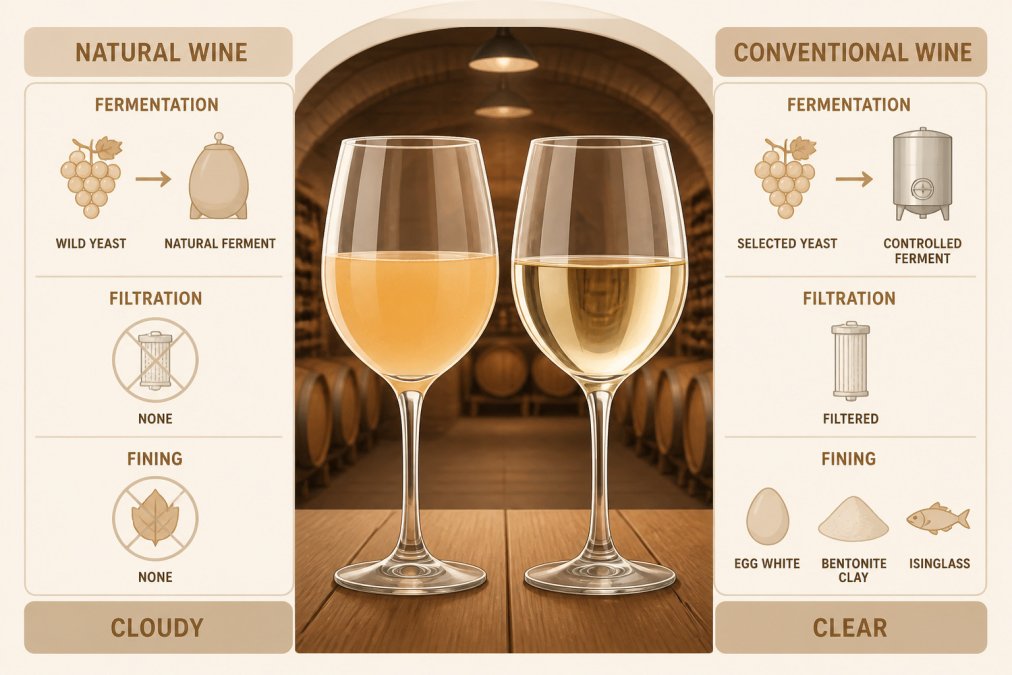
Filtration and fining are the two main clarifying steps. Filtration passes wine through a fine barrier to remove particles. Fining adds a substance, such as bentonite clay or egg white, that binds to particles so they settle out. Many natural wines are unfiltered and unfined, which is why they often look cloudy or contain small sediment.
Neither approach is automatically better. Filtered wine is usually brighter and more stable on the shelf. Unfiltered wine can show more texture, but it may throw sediment or change faster once opened.
Natural Wine Additives: What Is Allowed and What Is Not
Additives are the most misunderstood part of this topic. Conventional winemaking in the United States permits a long list of additions, including acid adjustments, tannin, oak products, and enzymes, within limits set by the TTB, the federal agency that regulates wine labeling. Natural winemakers typically aim to add very little, sometimes nothing beyond a small amount of sulfur dioxide. This minimalist approach shifts the focus toward the inherent character of the grape, prompting a deeper investigation into the health benefits of additives-free wine.
Here is a practical way to think about it:
- Minimal: Grapes only, native yeast, no additions except sometimes a small sulfite dose at bottling
- Low: A few additions, such as small amounts of sulfur at harvest or bottling
- Conventional: Broader use of cultured yeast, acid adjustment, tannin, or other permitted additives
Because “natural” has no legal definition in the United States, you cannot rely on the word alone. Ask the producer or look for a detailed back label.
Natural Wine Sulfites: Added Versus Naturally Occurring Levels
Sulfites are the most misunderstood number on a wine label. Two different things get called “sulfites”: the sulfur dioxide (SO2) that yeast naturally produces during fermentation, and the sulfur dioxide a winemaker adds as an antioxidant and antimicrobial. Every wine contains some of the first. Many wines contain some of the second. The label does not distinguish between them.
Why winemakers add sulfur. Oxygen is wine’s main enemy after fermentation. A small sulfur dose at crush or at bottling slows oxidation, protects aroma, and suppresses spoilage yeast and bacteria. Without any sulfur, a wine is more fragile, it may brown faster, referment in the bottle, or spoil sooner after opening. That trade-off is why even many low-intervention producers add a small amount at bottling rather than none at all.
How the rules work in the United States. Under FDA labeling rules, wines containing sulfites at or above a set threshold must carry a “Contains Sulfites” statement. That threshold is a labeling trigger, not a safety limit, and it is low enough that essentially all wines, including many with no added sulfur, carry the statement. The TTB, which regulates wine labeling and advertising, also restricts sulfite claims, and organic-labeled wines face separate limits under the USDA National Organic Program.
Learn More About Events at Aspen Sky →
What the numbers look like. Total sulfite levels vary widely by style and producer. Many conventional wines sit in a broad middle range, while low-intervention producers often aim lower, but “lower” is not “zero,” and a bottle with no added sulfur can still contain naturally occurring sulfites. Because the label reports only whether the threshold is crossed, not the actual level, you cannot rank two bottles by sulfite content from the label alone. Ask the producer or check a technical sheet if this matters to you.
The headache question. If you have a diagnosed sensitivity, talk with your doctor before relying on any label claim.
The practical rule: “Contains Sulfites” tells you the wine crossed 10 ppm, not how much sulfur was added. To compare bottles, ask about added sulfur at bottling, not the presence of the statement.
The sulfite label is easy to misread, so here is how the main sulfur-related facts compare.
| Term | What it means | Label reality |
|---|---|---|
| Naturally occurring SO2 | Produced by yeast during fermentation | Present in every wine |
| Added SO2 | Antioxidant and antimicrobial, added by winemaker | Often added at crush or bottling |
| Contains Sulfites | Statement required above a set threshold | Triggered by crossing the threshold, not by added sulfur |
| 10 ppm | Labeling threshold cited in the article | Not a safety limit |
| No added sulfur | A wine can still test above 10 ppm | Natural levels remain |
Natural Wine Taste: Why Bottles Vary So Much
Taste is where natural wine earns both its fans and its critics. Wines made with native yeast and little intervention can show more savory, funky, or herbal notes. They can also show more variation from one vintage to the next, or even from one bottle to the next.
That variation is not a flaw in the eyes of many drinkers, but it can surprise people who expect the same flavor every time. A conventional wine usually tastes consistent because winemakers use controls to lock in a house style.
Serving temperature, age, and whether a bottle has been stored well also shape the taste.
Reading Labels and Choosing a Bottle for Your Next Dinner
Most wine labels are designed to sell a place and a story, not to disclose production methods. The terms that matter for this comparison fall into three tiers, and knowing which tier a word belongs to is the fastest way to read a shelf.
Tier 1: Regulated terms. “USDA Organic” on a wine label is backed by the National Organic Program and carries specific rules for both grape growing and winemaking, including limits on added sulfites. “Made with organic grapes” is a weaker claim: the grapes were certified organic, but the winemaking rules are looser. “Biodynamic” is a farming philosophy with its own certification bodies; a certified biodynamic wine has passed an audit, while an uncertified producer using the word has not.
Tier 2: Voluntary standards. A handful of trade groups and regional bodies publish their own natural-wine standards, with limits on additives, sulfur, and farming. These are not government regulations, and they vary by organization, one standard’s ceiling may be another’s floor. When you see a small logo on the back label, look up the standard behind it rather than assuming the word “natural” carries legal weight. In the United States, it does not: there is no federal definition of natural wine.
Tier 3: Marketing words. “Natural,” “clean,” “minimal intervention,” and “low-intervention” have no agreed legal meaning. They are useful signals of intent, not guarantees. A producer using them may farm organically and add nothing, or may farm conventionally and add a little sulfur, the word alone will not tell you which.
Questions that actually sort bottles. When you are choosing for a dinner, ask the retailer or tasting room staff:
- Were the grapes grown organically or biodynamically, and is that certified?
- Was the wine fermented with native or cultured yeast?
- Was any sulfur added, and roughly how much at bottling?
- Was the wine filtered or fined?
- Is this a consistent house style, or does it vary by vintage?
Those five answers tell you more than any single word on the front label, and they let you match the bottle to the meal. A fresher, lower-intervention white often suits salads, seafood, and simple roasted dishes; a richer conventional red may carry a heavy meat course. For a group, ask for a few styles and let guests compare pours, the contrast is the point.
Photograph the back label before you buy. Producer name, region, certification logo, and any sulfur note are the four details worth remembering when you want to find the bottle again.
If you want to taste these styles side by side, visit Aspen Sky to plan a visit or check our current tasting options.
Frequently Asked Questions
What is the difference between natural wine and conventional wine?
Natural wine generally refers to wine made from organically or biodynamically farmed grapes, fermented with native yeasts, and made with little or no filtration, fining, or added ingredients. Conventional wine may use synthetic pesticides and fertilizers in the vineyard, commercial yeasts, and cellar techniques such as filtration and fining to achieve a consistent, clear product. In the United States, there is no federal legal definition of natural wine, so the term on a label is not a certified standard. Check the producer’s own description and any certification before assuming a bottle fits the category.
Is natural wine healthier than conventional wine?
The evidence does not support a blanket claim that natural wine is healthier. Both styles contain alcohol, and alcohol consumption carries health risks regardless of how the grapes were farmed. Natural wines can contain sulfites too, sometimes at levels similar to conventional bottles. Treat health claims about either category with skepticism and moderate your overall alcohol intake.
Are sulfites added to natural wine?
Many natural wines contain little or no added sulfites, but some producers add small amounts for microbial stability, particularly for bottles that will travel or age. Sulfites also occur naturally during fermentation, so even wines with no added sulfites contain some. In the United States, wines containing sulfites at or above a set threshold must carry a ‘contains sulfites’ statement. Read the back label or ask the producer for the total sulfite level if it matters to you.
How can you tell whether a wine is natural?
Look for producer descriptions that mention organic or biodynamic farming, native or indigenous yeast fermentation, and minimal additives, but recognize that ‘natural’ is not a regulated label term in the United States. Certifications such as USDA Organic apply to farming and to wine made with specific ingredient limits, and they do not cover every natural winemaking practice. The most reliable approach is to ask a retailer or the winery directly what the vineyard and cellar practices were for that vintage.
